OID in modern corporate debt: Timing, yield, and reporting considerations
A company is facing a financial crunch. Within a matter of months, it closes on a three–year convertible bridge note. The note bears interest at 5%, payable only at maturity, and includes variable conversion rights upon the occurrence of specified events. The company describes the note as a debt instrument and a bridge to its next financing round; the investor views the note as an early equity opportunity. For income tax purposes, however, if the convertible note is treated as debt, it may give rise to income and deductions on a daily basis before a single share is ever issued.
Although original issue discount (OID) is commonly associated with traditional bonds, it frequently arises in modern financing arrangements, including bridge notes, convertible notes, and payment–in–kind (PIK) instruments. Because financing documents rarely use the terms “OID” or “discount,” practitioners may overlook the need for an OID analysis. Misapplication of these rules can produce unexpected results. Holders may be required to recognize interest income before receiving cash. They may also later discover that conversion of the instrument does not solely produce capital gain or that the instrument is not stock eligible for the qualified small business stock exclusion under Sec. 1202. Issuers may have missed deductions or may face penalties for late or incorrect reporting. For these reasons, OID should be analyzed when the instrument is issued rather than after tax reporting issues surface years later.
Threshold issue: Is the instrument debt?
Debt and equity characterization can produce materially different tax consequences for the parties, and that determination should be made at issuance. Analyzing and documenting the treatment only in hindsight can create significant practical challenges, including strained investor relations where the parties’ expectations were not aligned or where income and expense were not reported consistently.
In evaluating whether an instrument should be treated as debt or equity, Sec. 385(b) identifies five relevant factors and authorizes regulations to expand upon them. These statutory factors include:
- Whether there is a written unconditional promise to pay a sum certain on demand or on a specified date, including a fixed rate of interest;
- The degree of subordination;
- The issuer’s debt-to-equity ratio;
- Whether the instrument is convertible into stock of the issuer; and
- The relationship between the parties.
The analysis, however, remains grounded in common–law principles and depends on all relevant facts and circumstances. It also extends beyond the four corners of the instrument. Courts have considered a broader range of other factors, including the name given to the instrument, the existence of a fixed maturity date, the source of payments, the holder’s right to enforce payment of principal and interest, participation in management, priority relative to other creditors, the intent and conduct of the parties, adequacy of capitalization, identity of interest between creditors and shareholders, the source of interest payments, comparability to arm’s–length lending, use of proceeds, and actual repayment history (Estate of Mixon, 464 F.2d 394, 402 (5th Cir. 1972)). These factors are not exhaustive, and no single factor is controlling.
Modern bridge notes often include both debt–like and equity–like features. For example, an instrument may provide for a stated maturity date, a stated interest rate, PIK interest, and creditor remedies while also including conversion rights at a discount, warrants, or other equity–linked features. Because these terms may point in different directions, characterization often depends on facts outside the agreement. Did the investor expect repayment in cash or conversion into equity? Did the company realistically intend and have the ability to repay the note at maturity? Would the holder enforce creditor remedies? These questions should be addressed at issuance rather than reconstructed in hindsight after a failed financing, pending transaction, or reporting correction.
The OID framework
Once an instrument is treated as debt for income tax purposes, the next step is determining whether OID exists. OID is broad and generally captures the contractual return on a debt instrument in excess of its issue price and qualified stated interest (QSI). QSI is stated interest that is unconditionally payable in cash or property — not simply accrued — at least annually. Interest that is merely accrued or payable only at maturity generally does not qualify as QSI. Interest is considered unconditionally payable only if the holder has legal remedies and intends to enforce timely payment (Regs. Sec. 1.1273–1(c)).
Bridge notes and PIK notes often lack QSI. As a result, stated interest on these instruments may be treated as OID and included in income by the holder over time, regardless of when cash is actually paid.
OID is statutorily defined as the excess, if any, of the stated redemption price at maturity (SRPM) over the issue price of the debt instrument (Sec. 1273(a)(1)). SRPM generally includes all payments due under the instrument other than QSI (Sec. 1273(a)(1)(A) and Regs. Sec. 1.1273–1(b)).
Issue price, as determined under Secs. 1273(b) and 1274(a), may vary depending on the type of consideration received by the issuer in exchange for the debt instrument. Conceptually, issue price is intended to reflect the amount paid — or the fair market value (FMV) of property transferred — to the issuer in exchange for the note.
Amounts paid for the use or forbearance of money may affect the OID calculation. Upfront fees generally reduce issue price (Regs. Sec. 1.1273–2(g)(2)), while premiums or similar amounts payable during the term generally increase SRPM (Regs. Sec. 1.1272–1(b)). For example, a 1% upfront lender fee on a $1 million note may reduce the issue price to $990,000. Similarly, a required repayment of principal plus a 10% premium may increase SRPM and create substantial OID.
OID may also arise where debt is issued as part of an investment unit that includes freestanding warrants. In that case, the aggregate issue price generally must be allocated between the debt instrument and the warrants, based on their relative FMVs (Sec. 1273(c)(2)). The amount allocated to the warrants effectively creates discount on the debt instrument, resulting in OID.
For example, assume a debt instrument is issued together with warrants for an aggregate purchase price of $1 million. The FMV of the debt is $960,000 and that of the warrants is $240,000. Based on relative FMVs, $800,000 of the aggregate issue price is allocated to the debt instrument: $960,000 ÷ ($960,000 + $240,000) × $1,000,000 = $800,000. Accordingly, the debt instrument has $200,000 of OID.
As with any rule, there are exceptions. The OID rules generally do not apply to short–term obligations with a maturity of one year or less (Secs. 1272(a)(2)(C) and 1283(a)(1)(A)) or to obligations that meet the de minimis exception under Sec. 1273(a)(3).
Example: Assume the following facts for a debt instrument:
- Issue date: Jan. 1, 2026;
- Maturity date: Jan. 1, 2029;
- Principal amount: $1 million; and
- Interest rate: 5%, compounded annually; assume the rate exceeds the applicable federal rate. The instrument is issued solely for cash, and the issue price equals the cash received, or $1 million.
In this example, the issue price equals the stated principal amount of the debt instrument. That result, however, should not be assumed in all cases. As discussed above, fees, premiums, warrants, and other economic features may cause the issue price to differ from the stated principal amount.
Using the note described in the example, and assuming there are no warrants or other additional features, the table “Interest Due at Maturity vs. Annually” compares those two payment structures.
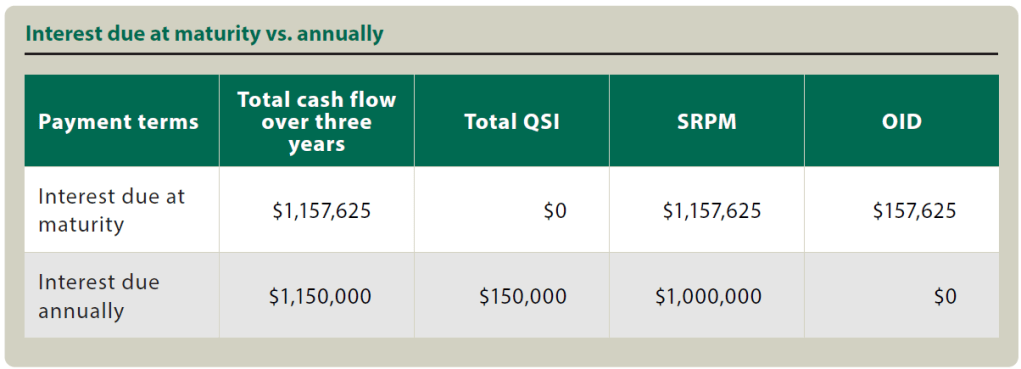
As presented above, if the holder does not have an unconditional right to receive stated interest at least annually, amounts that might otherwise appear to be stated interest may instead be included in the stated redemption price at maturity, potentially creating OID.
Timing and reporting
The issuer is responsible for determining whether OID exists, calculating OID under the constant–yield method, and satisfying applicable information–reporting requirements on Form 1099–OID, Original Issue Discount.
A domestic holder is required to include OID equal to the daily amount amortized for each day during the tax year in which the holder holds the debt instrument (Sec. 1272(a)(1)). This rule applies regardless of whether the holder, including an individual, is on a cash or accrual method of accounting. Accordingly, OID can create taxable income before any corresponding cash is received. Secs. 871(a)(1)(C) and 881(a)(3) override standard daily OID accruals for foreign lenders, deferring U.S. tax recognition until cash is paid or the debt is sold/retired.
Returning to the note example and the scenario where no cash interest is required to be paid until maturity, the holder must recognize OID annually under the constant–yield method. See the table “Recognizing OID Annually Under the Constant–Yield Method.”
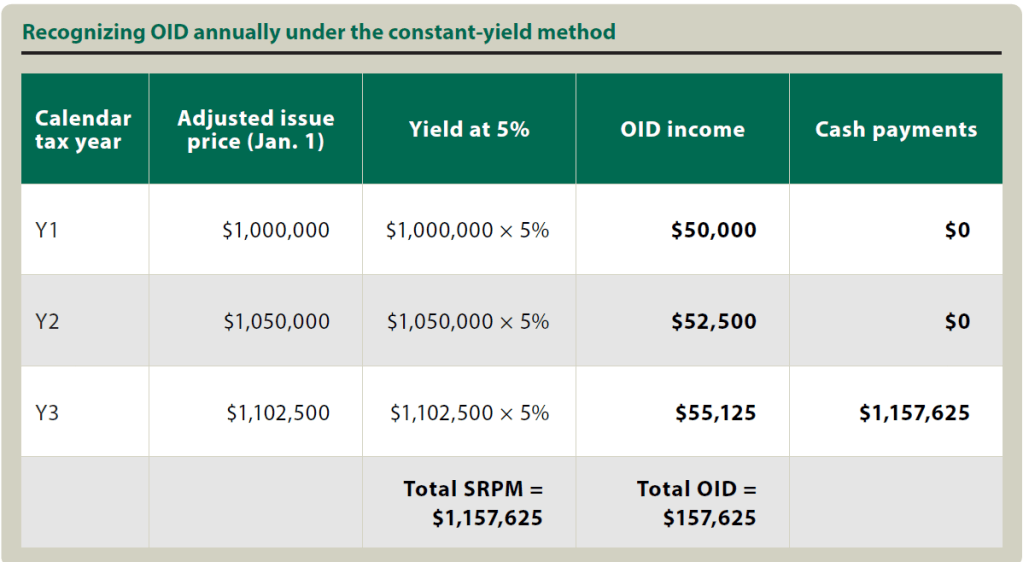
The annual inclusion represents “phantom” interest income because the holder recognizes taxable income before receiving any cash payments.
The timing mismatch can be even more pronounced when a debt instrument provides for a premium due with each principal payment. For example, assume the issuer is required to pay an exit fee of 10% on the $1 million principal. In that case, the implied yield increases from 5% to 7.94%, resulting in larger annual OID inclusions. See the table “Increase of Yield to 7.94%.”
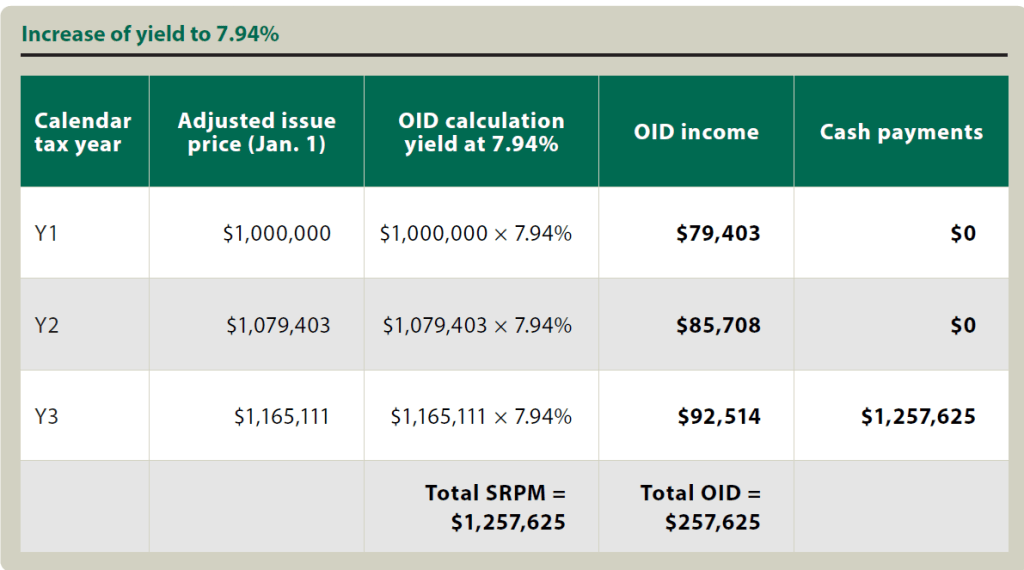
As these examples illustrate, OID can accelerate taxable income well before cash is received. Understanding those timing consequences is critical for both issuers and holders when evaluating the economics of a financing arrangement and the associated tax reporting obligations.
The issuer generally deducts OID under Sec. 163(e), using the same constant–yield methodology. OID is allocated daily over the term of the instrument, which aligns the issuer’s deduction with the holder’s income inclusion.
A common misconception is that Sec. 267 defers the deduction when the holder is a related cash–method taxpayer. Because OID is generally includable by the holder as it accrues, Sec. 267 generally does not defer the issuer’s deduction where the lender is following the mandate of Sec. 163(e). Exceptions may include foreign related–party lenders or where the lender has adopted an erroneous and impermissible method of accounting, which itself may require the filing of a nonautomatic method change on Form 3115, Application for Change in Accounting Method.
Another frequent issue involves failure to report the interest on Form 1099–OID. Issuers may fail to identify that an instrument is subject to OID; not recognize that OID is reported on the accrual method of accounting; improperly determine the issue price of an instrument; or overlook items that are included in the SRPM, such as warrants or exit fees. In either case, the issuer may fail to satisfy its information–reporting obligations or report incorrect OID amounts to holders.
Issuers must file Form 1099–OID with the IRS and provide a copy to the holder whenever the annual OID includable in a recipient’s income is $10 or more. Reporting deadlines are Jan. 31 for recipients and late February or March, depending on the method of filing, for the IRS. A failure to comply triggers tiered penalties based on the length of the delay; these penalties are inflation–adjusted and escalate significantly if the failure is corrected after Aug. 1, from $60 to $340 per required filing. Note that each form is filed in duplicate — one provided to the IRS and one to the lender — and two penalties can be imposed, one for failing to file a correct information return with the IRS (Sec. 6721) and one for failing to furnish a correct payee statement to the holder (Sec. 6722). The maximum penalty is generally $1,397,000 for small businesses and $4,191,500 for large businesses (all amounts are for 2026 tax–year filings; see Rev. Proc. 2025–32, §57). In cases of intentional disregard, the penalties increase to the greater of $680 per form or 10% of the reportable OID not reported, with no maximum annual cap.
Other considerations
Applicable high–yield discount obligations (AHYDOs): Sec. 163(e)(5) may defer in part and permanently disallow in part portions of OID deductions on certain high–yield corporate debt instruments that have significant OID. The AHYDO rules generally are applied to OID on debt instruments that have a maturity date more than five years from their issue date and a yield in excess of the applicable federal rate plus 5 percentage points, among other things.
Disqualified debt instruments: Sec. 163(l) permanently disallows interest deductions on certain debt instruments that are payable in — or where a substantial amount payable is determined by reference to the value of — equity of the issuer or a related party. Arrangements reasonably expected to result in such a transaction result in disqualified debt. The rules vary depending on whether the rights are those of the issuer or the holder. Therefore, convertible or equity–linked features warrant careful review at issuance. Further, these rules are one–sided and taxpayer unfavorable because they deny interest deductions but do not preclude cancellation–of–debt income.
Identifying OID early
OID extends well beyond traditional discounted bonds and frequently appears in modern financing arrangements, such as bridge notes and PIK notes, where payment obligations are not mandatorily required to be settled annually. Proper identification of OID is essential because the rules affect income recognition, interest deductions, information reporting, and potential penalty exposure.
A practical framework is to ask:
- Is the instrument properly characterized as debt or equity?
- What payment, conversion, or deferral features are embedded in the instrument?
- Are there warrants, premiums, exit fees, or other economic features that affect issue price or SRPM?
- Do any special rules, such as AHYDO, Sec. 163(l), or information-reporting requirements apply?
While these questions are not exhaustive, evaluating a debt instrument at issuance — and upon significant modification — can help identify timing and reporting consequences before they become costly. Early modeling of yield and cash flow consequences can improve reporting accuracy, manage stakeholder expectations, and reduce correction and penalty risk.
Editor
Jessica L. Jeane, J.D., is director of tax policy, national tax, with Baker Tilly in McLean, Va.
For additional information about these items, contact Jeane at Jessica.Jeane@bakertilly.com.
Contributors are members of or associated with Baker Tilly.
Baker Tilly Advisory Group, LP, and Baker Tilly US, LLP, trading as Baker Tilly, operate under an alternative practice structure and are members of the global network of Baker Tilly International Ltd., the members of which are separate and independent legal entities. Baker Tilly US, LLP, is a licensed CPA firm that provides assurance services to its clients. Baker Tilly Advisory Group, LP, and its subsidiary entities provide tax and consulting services to their clients and are not licensed CPA firms. The name Baker Tilly and its associated logo is used under license from Baker Tilly International limited. The information provided here is of a general nature and is not intended to address the specific circumstances of any individual or entity. In specific circumstances, the services of a professional should be sought. Tax information, if any, contained in this communication was not intended or written to be used by any person for the purpose of avoiding penalties, nor should such information be construed as an opinion upon which any person may rely. The intended recipients of this communication and any attachments are not subject to any limitation on the disclosure of the tax treatment or tax structure of any transaction or matter that is the subject of this communication and any attachments.